By Shingirai Masara (Opinion)
MAURITIUS IS widely regarded as one of Africa’s more successful economic transformation stories, having built a diversified economy anchored on strong institutions, openness to trade, manufacturing, tourism and services.
Over time, the country has shifted from a largely agriculture-dependent structure to a services-led economy, with the sector now contributing approximately 64 to 68 percent of gross domestic product.
Zimbabwe, which still relies heavily on agriculture and mining, continues to hold significant untapped potential in services exports.
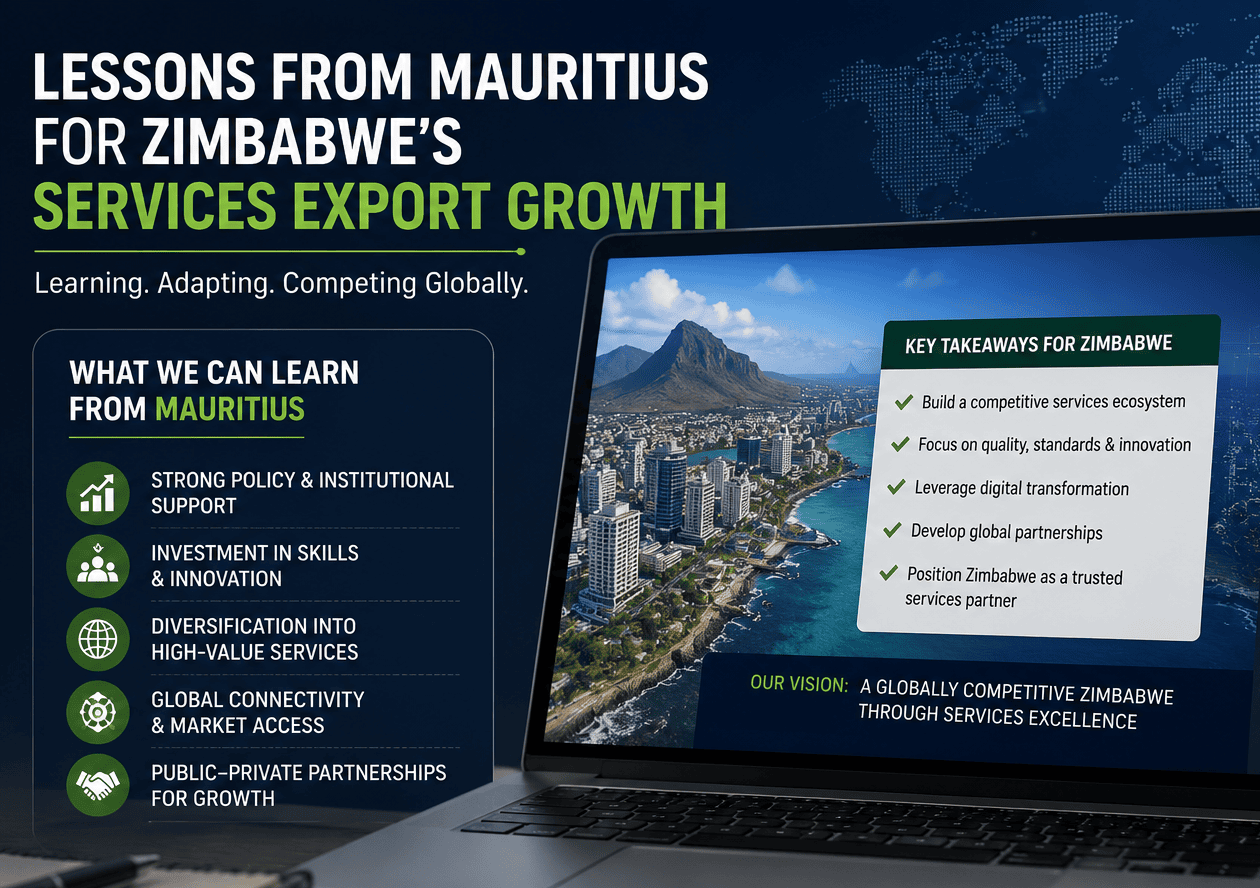
A review of the Mauritian experience offers practical lessons that could support the country’s efforts to expand and formalise its services sector as a driver of growth and foreign currency earnings.
Structural transformation: shifting towards a services-led economy
Mauritius deliberately pursued a long-term transition from an agriculture-dominated economy before the 1980s to a diversified services economy.
This shift was gradual and supported by consistent policy direction and institutional reform.
For Zimbabwe, a similar approach would require a clearly defined national services strategy aimed at increasing the sector’s contribution to GDP over time.
This would begin with a comprehensive audit of existing capabilities in financial services, information and communication technology, tourism and education services.
Based on such an assessment, measurable targets for services sector growth could be established, supported by sector-specific roadmaps designed to guide implementation across priority sub-sectors.
Developing financial services as a core economic pillar
Mauritius has developed a financial services sector that contributes around 13 to 14 percent of GDP directly, rising to approximately 25 percent when indirect effects are included, and supporting over 36 000 jobs.
The country has also positioned itself as an international financial centre serving markets in Africa and parts of Asia, supported by a stable regulatory environment and tax-efficient structures.
For Zimbabwe, strengthening financial services would require stabilising the monetary and regulatory environment to build investor confidence.
A credible and predictable policy framework remains central to the development of a competitive financial hub.
The establishment of a dedicated financial services regulatory framework, with clearly defined mandates like Mauritius’ dual-regulator model, would strengthen oversight and improve market confidence.
This would need to be complemented by the development of tax-efficient investment structures capable of attracting regional and international capital.
A structured medium to long-term growth strategy for financial services could support sector expansion, with emphasis on sustainable finance, digital transformation and improvements in the ease of doing business.
Zimbabwe’s geographic position within Southern Africa also presents an opportunity to position the country as a regional gateway for financial services.
Building a competitive tourism and hospitality export sector
Mauritius has developed a tourism-linked services sector that extends beyond accommodation to include transport, retail, travel services and other supporting industries.
The country has also diversified into niche segments such as eco-tourism, health tourism, business tourism and education tourism.
Zimbabwe already possesses strong natural tourism assets, including Victoria Falls, Hwange National Park and Great Zimbabwe, which provide a solid base for growth in tourism exports.
Expansion opportunities exist in developing niche tourism products such as health and wellness tourism supported by medical infrastructure, education tourism linked to regional academic demand, and business tourism driven by conferences, trade exhibitions and investment forums.
Improving supporting infrastructure, including accommodation standards, transport systems and travel services, would be key to increasing visitor spending and extending length of stay.
Policy incentives for tourism investment would further support sector growth, similar to Mauritius’ use of targeted policy support to strengthen accommodation and food services.
Leveraging ICT, digital services and business process outsourcing
Mauritius has actively developed ICT-enabled services and business process outsourcing, including call centres, back-office operations and data centres, supported by ICT parks and special economic zones.
These services are expected to remain important drivers of economic growth in the coming years.
Zimbabwe can build on this model by developing dedicated ICT parks and innovation hubs in cities such as Harare and Bulawayo, supported by reliable infrastructure and a conducive business environment.
The establishment of ICT-focused special economic zones could help attract investment through targeted incentives, simplified regulatory processes and improved utility services.
Investment in broadband connectivity and digital infrastructure would be essential to improving competitiveness in global outsourcing markets.
Zimbabwe’s strong literacy levels and English-speaking workforce provide an advantage in targeting international business process outsourcing opportunities.
Additional growth potential exists in fintech development, which has become a key focus area within Mauritius’ regulated digital services sector.